


Renewal, growth & recognition
President Downs’ Strategic Plan highlights identity, enrollment, service and finances to guide university for next five years
By Billy Liggett
Photos by Ben Brown and Bennett Scarborough
The Inauguration | A Week to Remember | It’s Good to Be Home
When President William Downs delivered on his Day 1 promise of a strategic plan for Campbell this spring, he revealed four pillars — enrollment growth, financial strength, community impact and institutional identity — that would guide the University’s decision making during his first five years in office.
While all are vital to Campbell’s survival in an increasingly challenging higher educational landscape, it’s the fourth pillar that Downs suggests might be the most important. From the beginning, when founder Baptist minister J.A. Campbell held his first class in a small school house and started the day with a hymn and a Bible passage, faith has been the University’s pilot.
“It’s the DNA of this school,” says Downs. “I’ve seen schools where you couldn’t pray. I’ve seen schools use faith instrumentally, rather than authentically. I think in this country today, there is a huge appetite with young people for authentic spirituality. I don’t think they care as much about denominations, but there is a hunger for spiritual formation and growth.
“To be at a place like Campbell where you can live out your personal faith and build it authentically … that’s impact. We need to lean more into that.”
Downs unveiled Campbell University 2026-2031: A Strategic Plan for Renewal, Growth and Recognition in early February after it was unanimously approved by the Board of Trustees on Jan. 28. In it, he and a committee of faculty, staff, students and alumni committed to strengthening Campbell’s broader reputation as a Christ-centered institution of higher education and a school that embraces the conviction that there is no conflict between the life of faith and the life of inquiry.
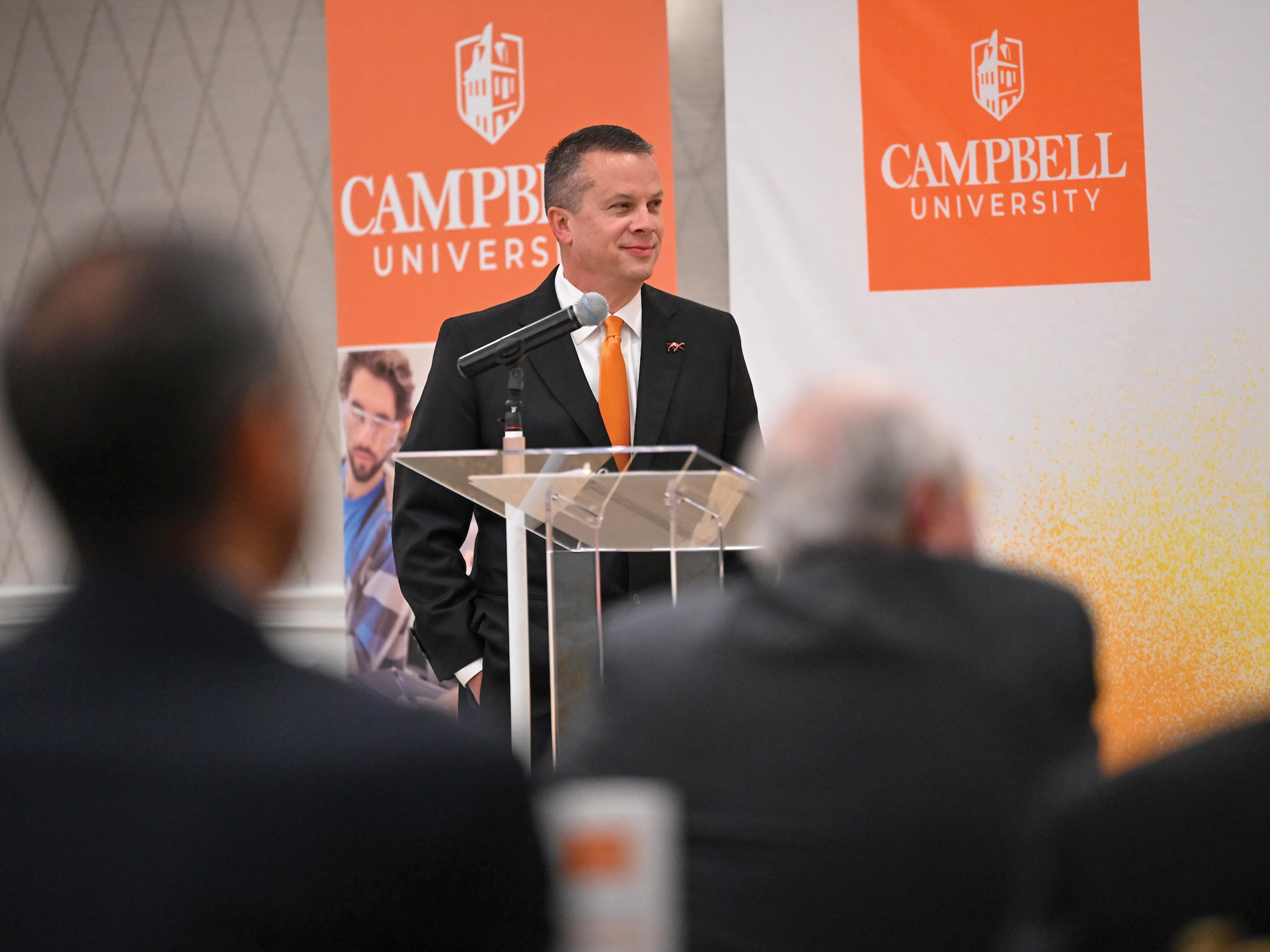
“When I first started the interview process for this job, there was a ‘D-word’ floating around, ‘drift,’” Downs says. “There’s worry that Christian colleges and universities have drifted away from their faith foundations. And I think many have. It was clear to me this was a place that was ready to lean back into faith and of the other three pillars of the strategic plan. Faith is the one that has received the most attention, and it’s received the most enthusiasm and love from across this community.”
The strategic plan was the work of a 12-person committee tasked to chart a pathway to “more fully and faithfully realize our existing institutional mission,” Downs said in a letter to the community on Feb. 4.
“The challenges and opportunities we face require our immediate attention, and it was imperative to set our vision to paper so that we could then get busy fixing, building and growing,” he wrote. “I have preached ‘controlled urgency’ since my first day at Campbell, and that has been our approach to completing this major strategic task.”
Downs became Campbell University’s sixth president on July 1, 2025, and one of his first actions as president was creating the committee that oversaw the creation of the new plan. Over the course of months, the group administered a survey that generated more than two thousand responses from alumni, students, administrators, trustees and faculty and staff. Those responses shaped the conversations in three 90-minute town halls held during the fall that led to open discussion from faculty, students and staff.
Downs also hosted 10 one hour-long listening sessions with units across the campus to draft the plan’s strategic priorities. Those priorities — enrollment growth, financial strength, community impact and identity — were the same priorities Downs said were communicated to him during the interview process before becoming president.

“Trustees, alumni, students and staff all made it abundantly clear that these were institutional priorities. Those early signals were subsequently reinforced throughout my first months at Campbell in conversations across campus and in our broader community. They then reappeared in the survey data analyzed by our planning committee.” Downs said. “Settling on these four themes as the core pillars of Campbell’s new Strategic Plan was perhaps the easiest part of our work … everything we heard and everything we now know tells us that our University’s future hinges on enrollment growth, robust financial health, constructive engagement with the community and a sharpened understanding of our identity.”
In his letter to the Campbell community, Downs laid out several scenarios of what Campbell will look like in the next five years as a result of the Strategic Plan. Campbell, he said, will be home to more students from its backyard and across the nation and the world. More students will continue their education at Campbell after beginning in community colleges, and pathways toward a graduate education at Campbell will be better defined.
Also in five years, Campbell will be well into its most ambitious, comprehensive fundraising campaign to date, and the financial health of the institution will be more sound.
“Campbell will be better and stronger in 2031 if we have become a destination of first choice for more students,” Downs said. “Increased enrollment means that we have become more closely aligned with what prospective students want, with what employers need, and what our society demands. Enrollment growth, increased philanthropic support, greater fiscal discipline and more aggressive pursuit of external funding will enhance our financial health. A financially healthy Campbell is one that provides students with the services they expect, one that compensates its employees appropriately, and one that has the means to realize its dreams.”

Then there’s the all-important faith element. The plan will ensure that Campbell’s Christian identity is more clearly and consistently reflected in both internal and external marketing and communications efforts, including social media and Campbell Magazine. More endowed scholarships will be awarded to incoming undergrads based on character and not solely based on GPA and other traditional measurements. Campbell will also improve onboarding of new students to better educate them on the school’s history and its Christian foundation. Finally, Butler Chapel will see increased use as a venue for worship and spiritual formation by not only students, faculty and staff, but the greater Campbell community as well.
In his inauguration speech on March 27, Downs said Campbell will rededicate itself as a “gathering space for people from all backgrounds who wish to live, learn and grow in a thriving Christian community.” Strengthening the faith element of a Campbell education, he said, will help the school secure its reputation as North Carolina’s top producer of graduates prepared for lives of service leadership.
Downs said a university that dares to dream big is one that will become inextricably linked to the fortunes of its surrounding community. He said Campbell can and should be a partner and a catalyst for progress in the Triangle region.
“Campbell will be better and stronger in 2031, because we will define ourselves not by explaining who we are not, but by confidently knowing precisely who we are,” he added. “Put all these things together and Campbell at the close of this initial five-year plan will be better off because it will be busy faithfully fulfilling the mission we have all been blessed to inherit.”
Pillars of the Plan
Enrollment Growth: Campbell commits to more effective fulfillment of its mission through a University-wide effort to achieve sustainable growth in overall student enrollments, with a target of 2 percent average annual growth over the five-year planning period (net increase of roughly 500 students).
Financial Strength: Campbell commits to strengthening its financial health by ensuring that annual revenues regularly exceed expenses, expanding and diversifying revenue streams, increasing philanthropic support, remedying a backlog of deferred maintenance issues and investing in employees in ways that reward merit.
Community Impact: Campbell commits to becoming the region’s most vital private educational partner for economic growth, workforce development and improved health care. We will actively cultivate opportunities to expand Campbell’s geographic footprint in other areas of the state.
Institutional Identity: Campbell commits to strengthening its broader reputation as a Christ-centered institution of higher education, as a gathering space for people from all backgrounds who wish to live, learn and grow in a thriving Christian community, and as the state’s top producer of graduates prepared for lives of servant leadership.