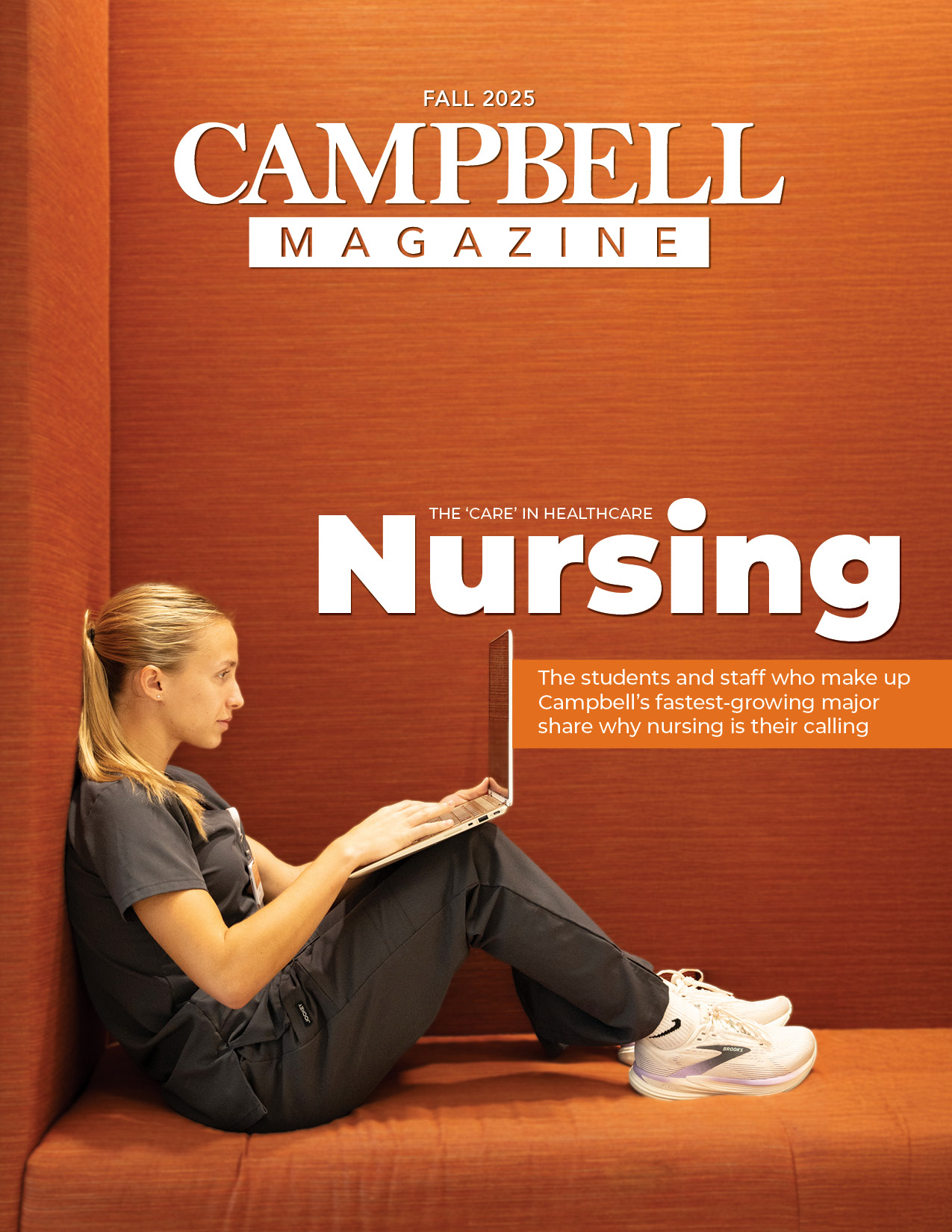
THE ‘CARE’
IN HEALTHCARE
The students and staff who make up Campbell’s
fastest-growing major share how and why
nursing became their calling
By Billy Liggett
Emily Pierce was in second grade when she underwent the first of two brain surgeries after being diagnosed with Chiari malformation, a rare defect of the cerebellum, which controls balance and movement.
As frightened as any 7-year-old would be before such a major procedure, Pierce says it was the floor nurses who took multiple hours talking her through everything at her level and putting her at ease leading up to surgery.
Her mother, a certified registered nurse anesthetist, showed her what the mask that put her to sleep would look like … how she’d feel when she went under and after she woke up.
“It was the nurses who took such great care in explaining what was going to happen — all of that stuck with me,” she says.
When she battled pneumonia shortly after her procedure and when she had to return to the operating table five years later for a follow up, nurses were there, by her side, holding her hand and guiding her through her medical journey.
Pierce would overcome the surgeries, a 42-degree scoliosis curvature in her spine and having to wear a back brace at times to become an accomplished athlete — she’d score 21 goals and dish out 20 assists in two years of varsity soccer and play two years of varsity basketball for Eno River Academy in Hillsborough.
Surprisingly, considering her condition, she excelled most in cross country, where she was captain of her team for multiple years and finished ninth overall in the Class 1A state cross country meet in 2022.
Not surprisingly, when it came time to consider a career, for Pierce, it was always nursing.
When choosing colleges, she wanted a school where she could continue to run and a school with a strong nursing program. Campbell University — which launched the Catherine W. Wood School of Nursing in 2016 — checked all the boxes for that next step. Now a junior, Pierce is excelling as a long-distance runner at Campbell. She holds the program’s record in the women’s 4K, and she has the fifth-fastest mark in school history in the 5K race.
 She’s also entering the first year of a two-year Bachelor of Science in Nursing (BSN) curriculum at Campbell, a program that — in a short time — has grown to house one of the University’s most popular undergraduate tracks. Pre-nursing has become one of Campbell’s top freshmen majors, and the School enjoyed its largest incoming class this fall.
The program’s popularity comes at a pivotal time for the profession, both in North Carolina and nationally. Statewide, the shortage of 12,500 registered nurses is expected by 2033, according to a 2021 study by the Cecil G. Sheps Center for Health Services Research at UNC-Chapel Hill. The North Carolina Center on the Workforce for Health says 13 percent of the state’s registered nurse positions are unfilled (higher than the national average of 10 percent).
Campbell-educated nurses are eating into that shortage and can be found all over the state. The program is currently capped at about 100 students and takes in roughly 50 each year among a field of pre-nursing candidates who have spent their first two years taking core classes and electives.
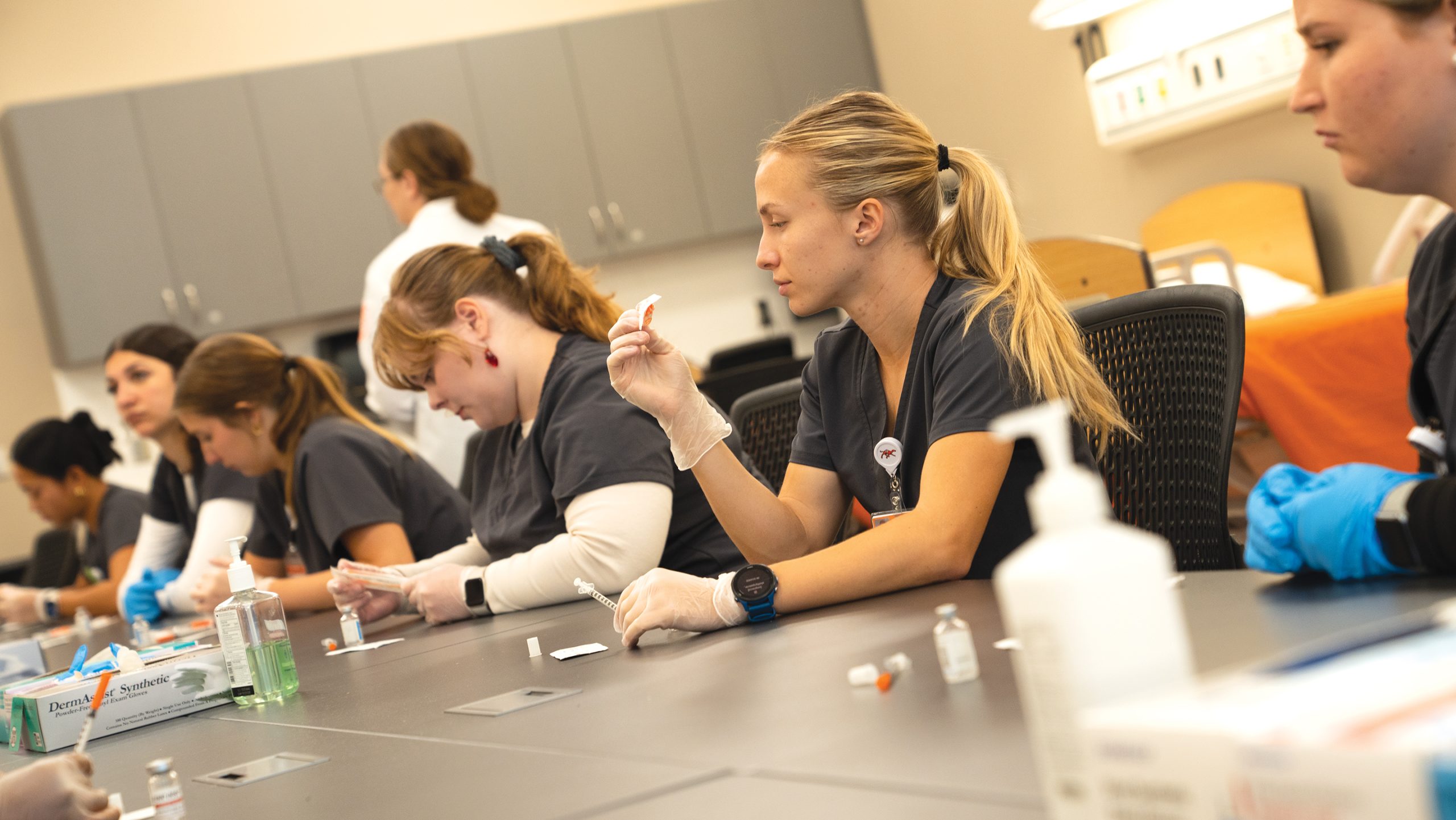
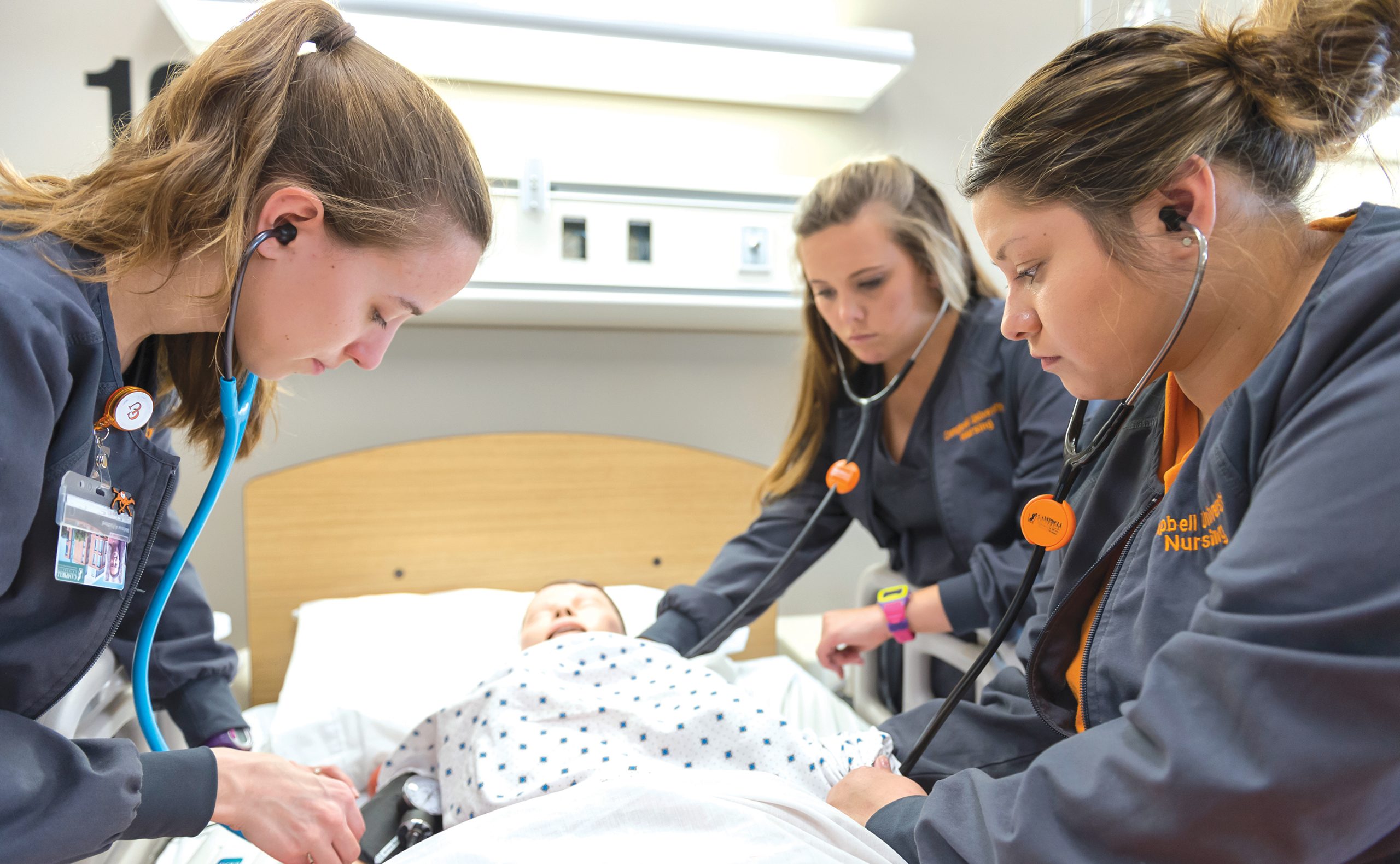
Campbell Nursing touts a strong interprofessional setting where nurses can work alongside future physicians, physician assistants, physical therapists and pharmacists and offers modern simulation facilities and hands-on opportunities in regional hospitals and clinics.
“I really enjoy coming to this beautiful building every day and getting to work with a lot of other professionals and students in [osteopathic medicine] and physical therapy,” Pierce says. “We have to dress up every day, which I also really like — it all just feels really professional, and the way the program is set up, because the focus is all nursing in the final two years.”
She compares the curriculum to a graduate program within an undergraduate program. The final two years are all nursing — classroom courses, hands-on labs and clinical rotations have the feel of masters-level courses.
“Everything they’ve put in place … it really feels like you’re getting ready for your career,” Pierce says.
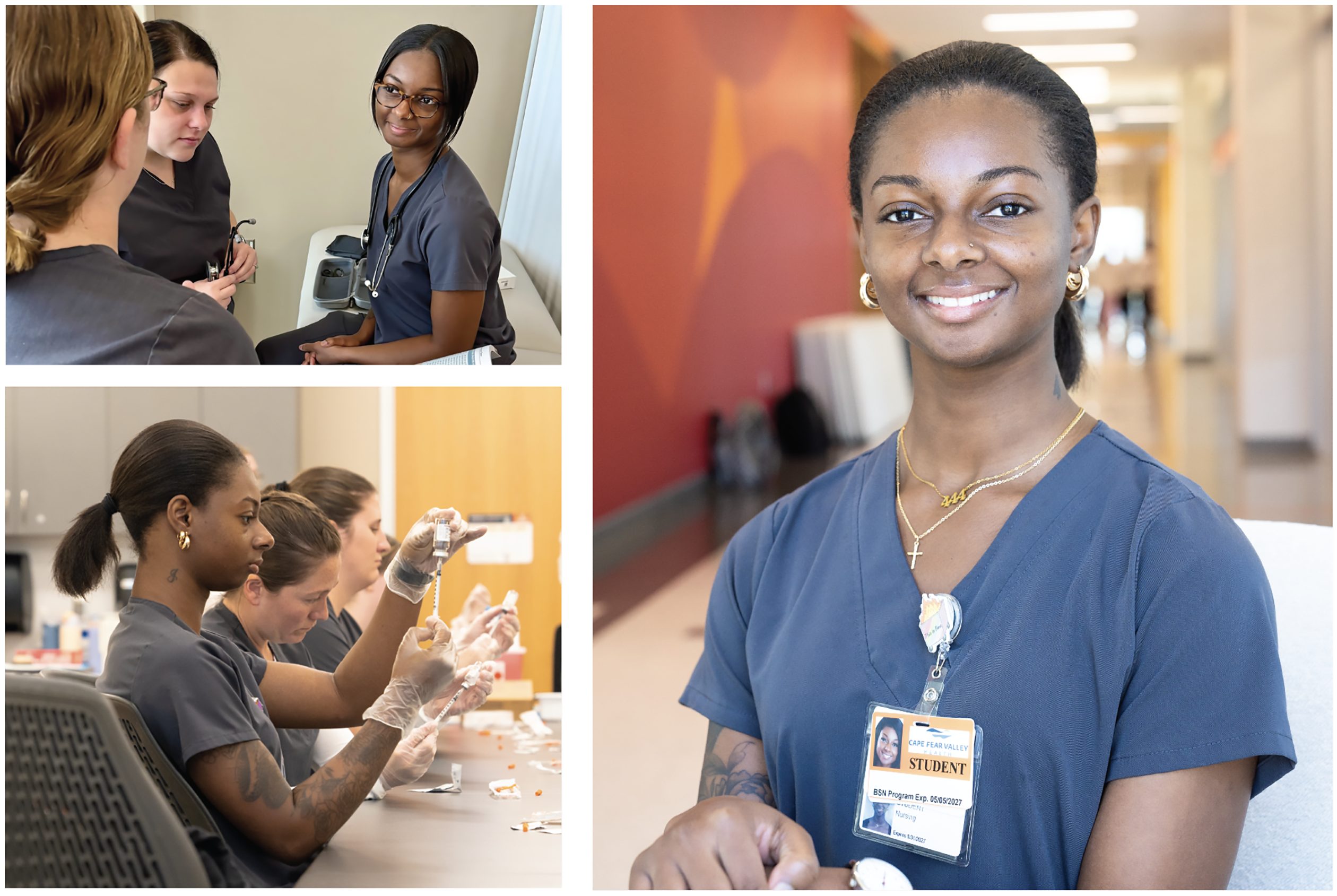
Like her classmate, Annapolis Shaw needed nurses as a child.
Both she and her brother were born with a condition that required major surgery as an infant. She survived the procedure. Her brother did not.
“I know the doctors and the nurses did everything they could to save both of us,” she says. “I’m here today because of them, and one day I want to be there for other children and make sure they come out the other side feeling loved and cared for. I want to be a part of giving them a second chance at living a long, healthy life.”
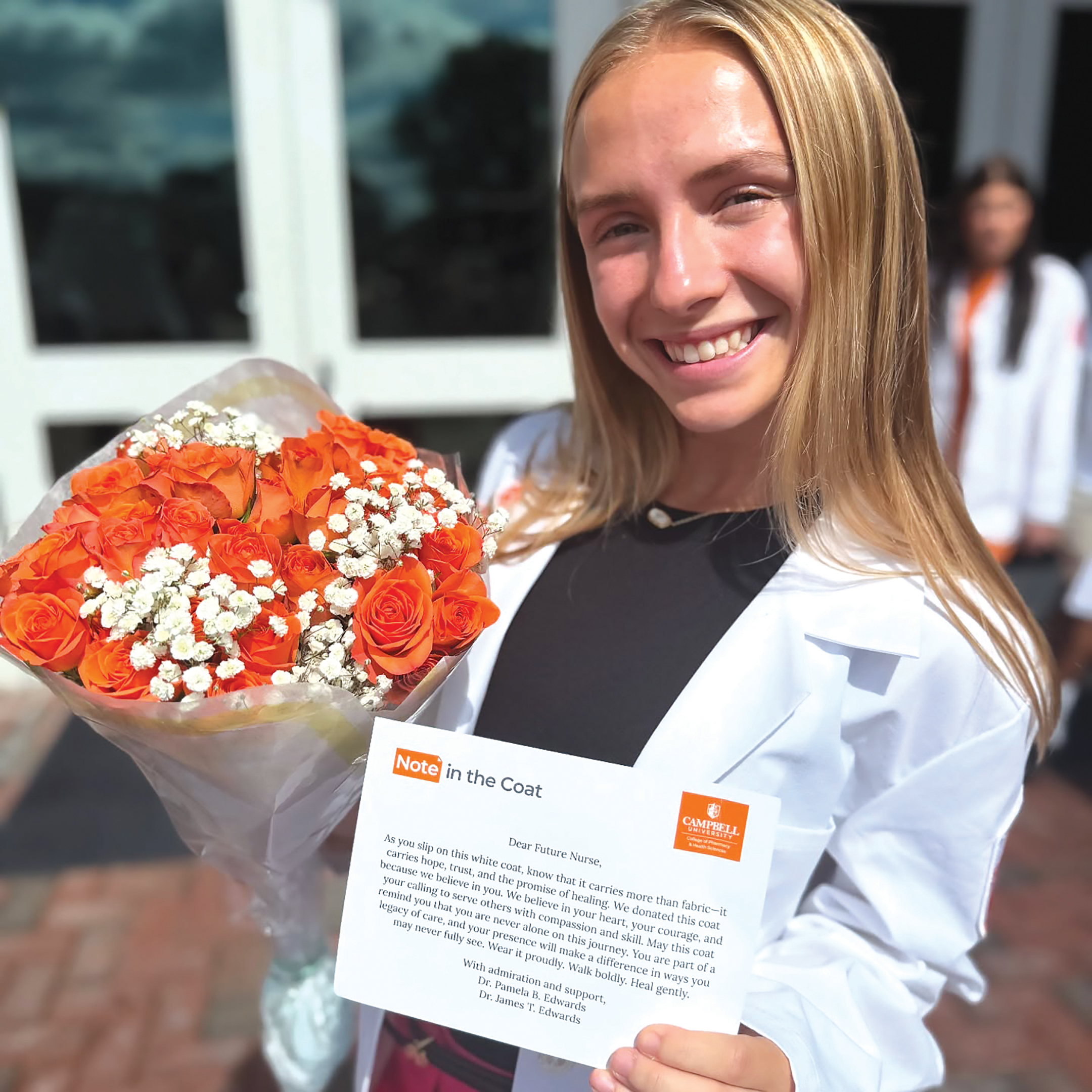
On the day of her White Coat Ceremony — held in August, it’s a celebration of each student’s acceptance into the competitive program — Shaw shared a photo on Facebook of herself as a baby, resting peacefully in an infant car seat while still hooked up to breathing tubes and various IVs and monitors. In her post, Shaw credited God and “those who worked tirelessly to save my life” in making it this far.
Currently a certified nurse assistant in Durham while she works toward her BSN at Campbell, Shaw says she’s seen up-close the difference a nurse can make in a patient’s health journey. Their impact, she says, can be greater than the doctors in charge.
“Nurses are there, around-the-clock, and I want to be that person who provides 24-7 care to somebody else,” she says. “I want to be someone’s light.”
When Campbell University announced its intentions to launch a nursing program in January 2014, then- President Jerry Wallace — fresh off starting a new school of osteopathic medicine — said the program would strengthen Campbell’s mission to “serve our neighbors by expanding access to healthcare, especially to those who are in rural and underserved areas.”
From the beginning, the program actively sought students like Shaw and Pierce, those with a passion for helping others. When the first class of 43 nursing students graduated in spring of 2018, founding Director Dr. Nancy Duffy said the students learned the most valuable tools every nurse needs — a brain, a mouth and a spinal cord.
“The brain to figure out what is happening to the patient, the mouth to speak for that patient and the spine to advocate for that student and see to it that their needs are always met,” Duffy said then. “They didn’t know what this meant on Day 1, but they get it now. We’re all about patient advocacy and clinical reasoning, and I’m satisfied that they understand this and are ready to integrate it into their practices.”
Campbell has since conferred more than 250 BSN degrees heading into the current academic year, which saw its largest class of incoming first-year student nurses. Current Director Dr. Pam Edwards, who came to Campbell in December 2023 after serving as assistant vice president of education at Duke University Health System, credits the program’s current success on several factors — smaller class sizes, modern facilities and clinical opportunities are but a few. She also says students enjoy Campbell’s faith-based mission and the program’s Christian worldview.
“I think there’s a spiritual nature about our students. They’re attracted to Campbell, because it’s different from other nursing programs,” Edwards says. “Every program is going to teach students that we take care of and respect all patients — no matter their background, their ethnicity, their gender or their sexual orientation. But Campbell adds that spiritual element. … We teach our students to be present and to be there with patients and families. Talk to them, touch them or just be present. That’s really all people want to know — that somebody cares for them.”
Pre-nursing has risen to become one of Campbell’s most popular majors for incoming freshmen. That makes for real competition for the between 40 and 60 open seats for those who wish to enter the BSN program as a junior. Edwards says the program looks at GPA and a resume that includes service projects and overall involvement.
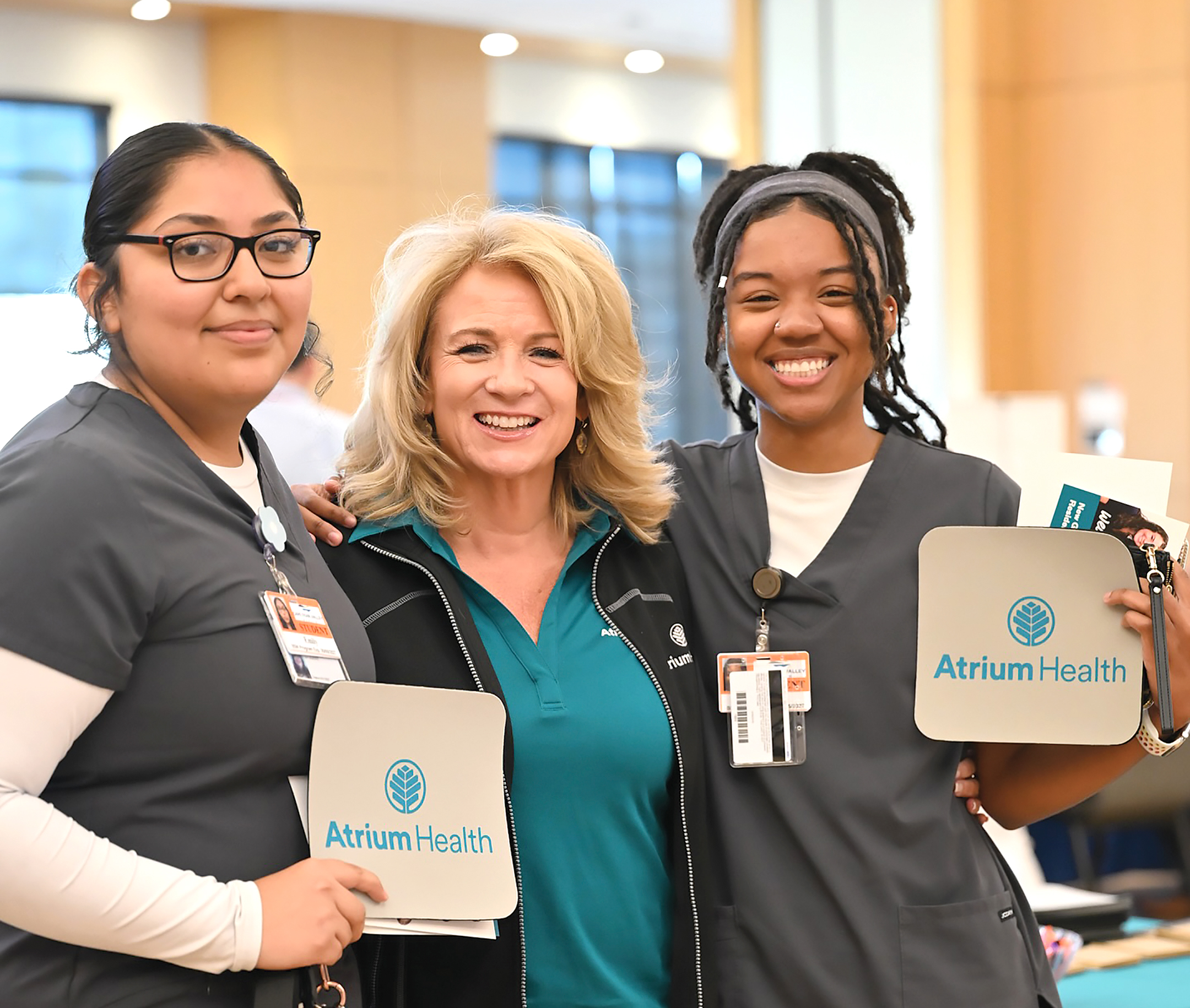
“We like to see a well-rounded student,” she says. “They’ll do either a written essay, or we’ll conduct an interview, which gives us a chance to learn more about the student as a whole. A student who may not have the best GPA can stand out in other areas — we haven’t gambled too often and seen it not pay off. And students who come into Campbell as a freshman and stick with the program have priority.”
The junior year begins with 300-level courses on professional nursing practice, fundamentals of nursing practice with older adults, health assessment and concepts of pathophysiology and pharmacology. Their second semester includes courses on research- and evidence-based practice and psychiatric and mental health practice. The senior year includes courses on leadership and health policy, nursing practice of women and children, nursing roles and population health, among others. The program requires 780 hours of clinical work, which includes skills labs and the simulation center. Students also travel to area hospitals, clinics, medical centers and nursing homes and long-term care facilities for their clinical work.
Students are required to dress “business casual” for the classroom and in their nursing uniforms for labs and clinicals. The attire requirements are another thing that distinguish nursing from other undergraduate programs at Campbell.
“It’s a professional program, and the students treat it as such,” says Abigail Blalock, the school’s new program manager, who joined in the summer. “You can tell the difference in their approach and demeanor [just weeks after] orientation. And I think the dress code is just part of what sets them up for success and getting used to working in a professional atmosphere.”
Few are bigger cheerleaders for the program than Krystle Edge, assistant director of nursing and assistant professor. A native of nearby Sampson County, Edge describes herself as “100 percent pro-nursing, all the time,” and says the profession was her calling.
“I used to sneak and read my mom’s anatomy books when I was 12, and I remember thinking I was doing something wrong at the time,” she says. “I learned all there is to know about the reproductive system before [most children].”
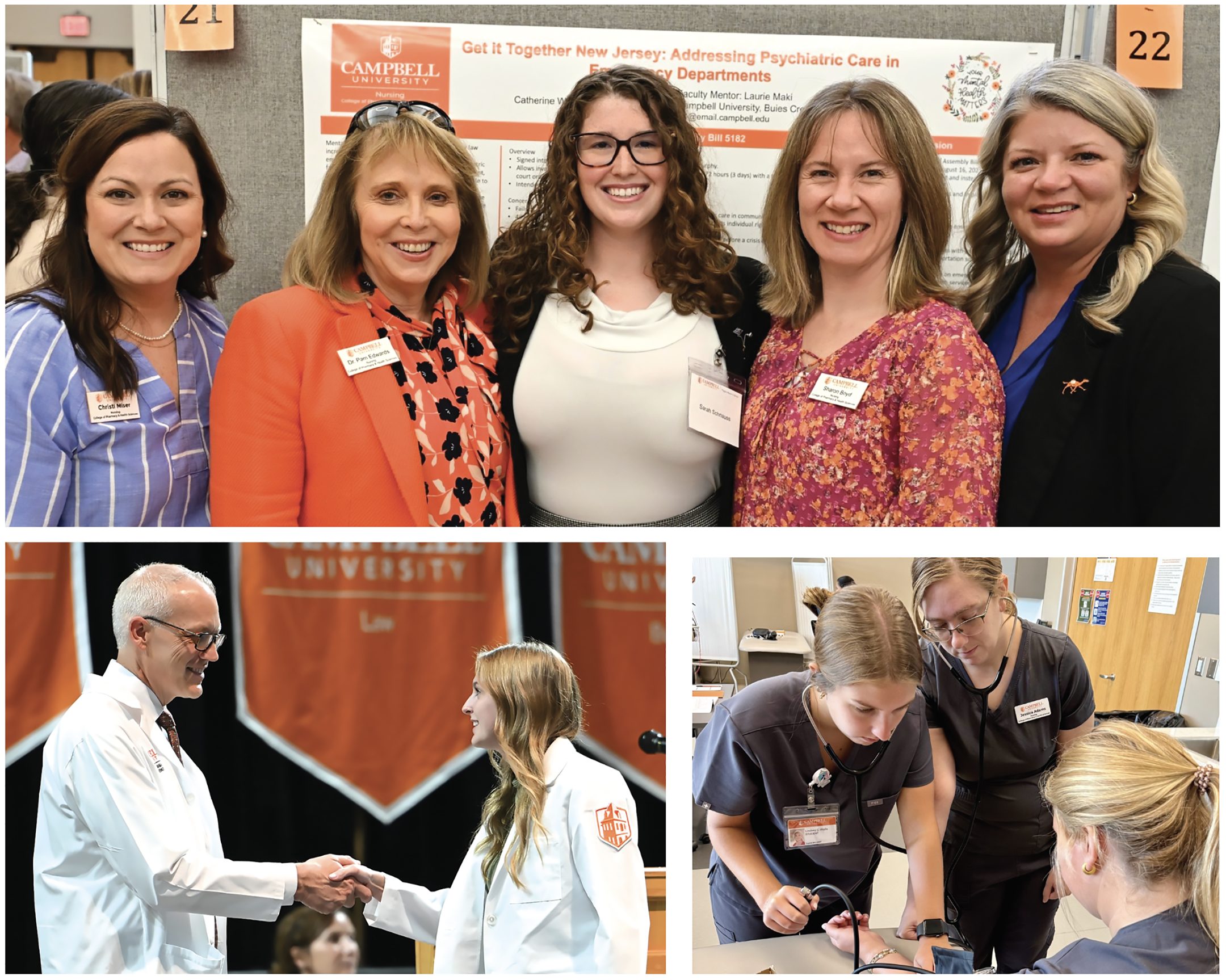
Edge was a registered nurse for Cape Fear Valley Medical Center in Fayetteville and at Betsy Johnson Hospital in Harnett County when she first became an instructor at Sampson Community College. She came to Campbell in 2019 as an assistant professor and was named Edwards’ assistant director in 2024.
She says one big thing Campbell’s program has going for it is its interprofessional setting. Nursing students are often seen working alongside physical therapy doctoral candidates in labs and during regular pro bono clinics that invite real patients — many of whom couldn’t afford it otherwise — to campus for free therapy. Nurses also work alongside medical and physician assistant grad students on Campbell’s health science campus and often in the field at free clinics or health fairs.
The program’s other big asset, she says, is its faculty.
“These students get faculty members who really care about them,” Edge says. “We want them to be successful. I’m not saying that doesn’t happen at other schools, but I know it’s real here.”
Shaw transferred to Campbell after enrolling in another nursing program — one that didn’t meet her expectations — and she says Campbell Nursing has exceeded her hopes just a few months into it.
“I love it so much,” she says. “I couldn’t have asked for anything better. Here you are equipped with professors and instructors who want you to succeed and will help you every single step of the way. They are completely 100 percent encouraging. Every day that you walk in, they are positive, and they speak into existence that you will be a nurse. And it’s just very uplifting for us. I love the atmosphere, and I love being able to actually challenge myself here.”
Pierce says Campbell’s strength is in its simulation labs and interprofessional settings.
“It all looks exactly like a doctor’s office or a hospital wing, and I think that’s preparing me more than anything,” she says. “I’ll admit I was really nervous when I got here, but the labs have prepared me. It feels like riding a bike now — I think I’ll be prepared for any challenge that comes my way.”
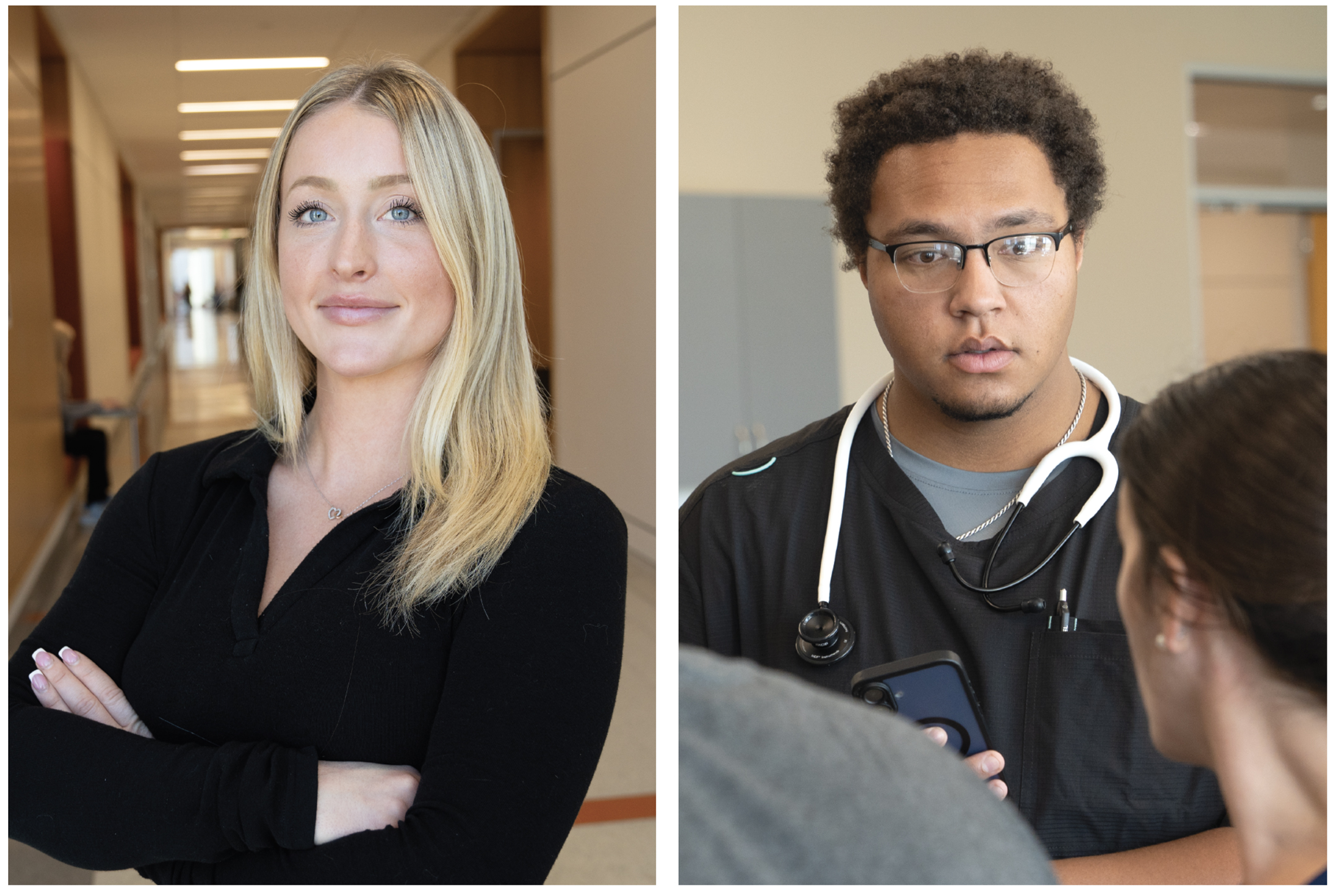
Cooper Wilson knows how to flip the switch.
He arrived in 2022 at Campbell University as Cooper Wilson, No. 73, offensive lineman from Hendersonville High School. He’ll graduate in May as Cooper Wilson, registered nurse. Both roles require being fleet of foot, quick decision making and grit. Both also lean heavily on teamwork The biggest difference: mean streaks don’t work as well in nursing. And compassion for the person across from you is frowned upon in football.
 For Wilson, compassion is part of his strength. His father was a nurse, and growing up, Wilson saw a man who brought joy to others and had a passion for helping his patients.
“I remember growing up, he just always said he loved what he did,” he says. “He’d work two different hospitals, two different units, and he enjoyed every minute of it. He just loved helping people, especially those who needed it most.”
When Wilson decided to follow in those footsteps and pursue a career in nursing while playing football at Campbell, his father gave him some advice — take nursing school seriously. It’s going to be difficult, he said. And when you graduate, the profession doesn’t get any easier.
In U.S. News & World Report’s 2025 list of the 15 most stressful jobs in the country, registered nurse ranked 14th and nurse practitioner ranked 12th (veterinarian technician ranked first, and other stressful careers included pilot, baker, construction worker and dental hygienist). This list said both nursing jobs are “physically and emotionally demanding due to long shifts, constant high-stress situations and caring for patients who are experiencing pain and distress.”
A 2025 Florida Atlantic University study found that stress, burnout and chronic short staffing all jeopardize the well-being of nurses and the quality of patient care in the U.S. Their findings found 65 percent of nurses report high levels of stress and burnout and more than two-thirds of student nurses are concerned about their potential workload after graduation.
Nurses leaving the profession due to burnout (much of it reaching its peak during the COVID pandemic) and to retirement — added to the rising number of elderly people in the U.S. and the increase in health care clinics and hospitals — are the biggest factors behind the current shortage of nurses at all levels in both North Carolina and across the country.
According to the North Carolina Health Talent Alliance, about 13 percent of the state’s registered nurses positions are unfilled. The number is higher for vacant LPN positions.
“We lost a lot of nurses during COVID — thousands in North Carolina alone,” says Edwards. “There’s, hopefully, not going to be anything like COVID again, but I hope we learned from that experience. We make sure our students know they are likely going to work in tough environments. We just finished up the N.C. Institute of Medicine report on nursing and the workforce, and the recommendations that came out of it were to increase the amount of time dedicated to teaching mental health and self care to our students. There were a lot of recommendations to improve workplace environments and to train nurses on how to handle incivility and bullying from patients and their families.”
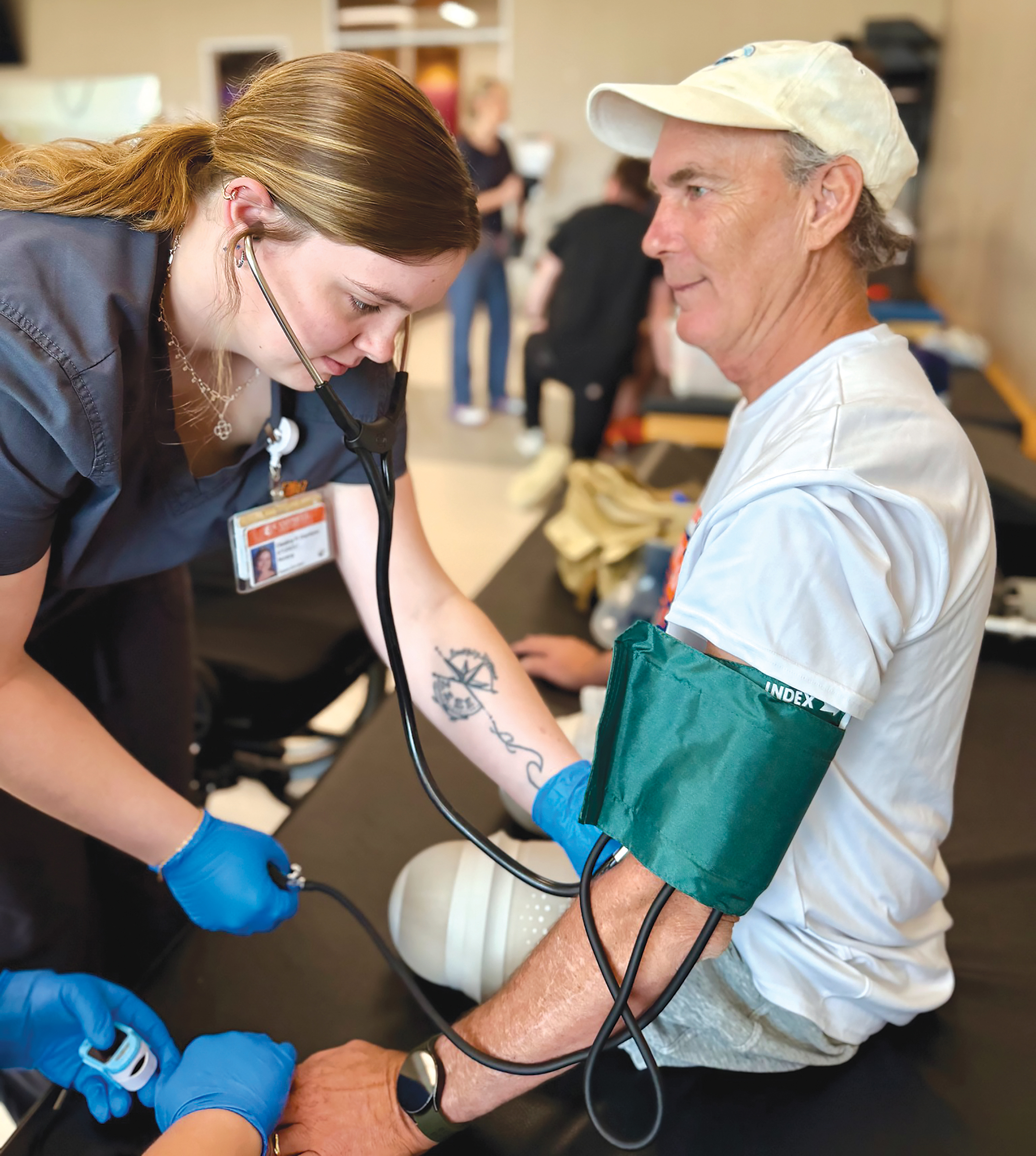
According to Edge, mental health — whether it’s dealing with patients with mental health issues or paying attention to one’s own health — is covered in every professional course in the nursing program.
As a child, Emily Pierce remembers seeing her mother come home from work crying because of a difficult day at work or because someone died under her care. When Pierce chose nursing, her mother talked to her about the difficult parts of the profession, but her focus was more on the rewards of being a nurse. One the flip side of U.S. News & World Report’s “most stressful jobs” list is their other recent list of “best jobs in America” and “best jobs in health care.”
Nurse practitioner — a position that requires a master’s degree and has a median salary in the U.S. of $126,000 a year — is the No. 1 job in the country, according to the 2025 list. Nurse anesthetist ranks 16th, and registered nurse comes in at 54th.
Pierce beams when asked about her future in nursing. She’ll be forever grateful to the nurses who cared for her during her own health scare, so she’s eyeing a career in pediatrics, hopefully as a nurse practitioner.
“My goal is to be able to connect with my patients and make them feel better and make their day better — to make someone smile during their most vulnerable moments,” she says. “With kids, even the smallest thing you can do can mean the world to them. Having gone through it all myself, I can tell them that their setbacks are going to be the reason they come out stronger.”
She says every time she steps to the white line before a long-distance race, she thinks back to her surgeries. She reminds herself that she’s come this far despite all of it.
“I remember the days I couldn’t get out of bed. Those were the hardest days of my life, but I was grateful that I had a great support system. I know not everyone has that, so [as a nurse], I want to be that support. I want to tell them to never give up. They may not realize how important that is in the moment, but if they’re like me, they’ll always remember it.”