
John Andrzejek helped build a national champion at the University of Florida. His arrival at Campbell comes with big opponents on big stages and big dreams to form a winner in Buies Creek.
Amid the confetti, the tears and the hugs in the moments following the University of Florida’s national championship in men’s basketball last April, John Andrzejek’s thoughts returned to a high school baseball game — yes, baseball — 16 years earlier.
He was a sophomore that year and a starter for a Hamilton High School baseball squad that rode a 20-4 record all the way to the 2009 New York Class D state semifinals. His Emerald Knights were down 2-1 heading into the final inning of a pitchers’ duel against the Arkport Blue Jays, and after a leadoff single and a sacrifice bunt that moved the runner to second, Andrzejek was up with one out and a runner in scoring position.
A chance to be the hero. “And I tagged one pretty good,” he recalls, his smile giving way to a wince. “But I hit it right at the first baseman. Out. Then my buddy came up next and flew out to center to end the game.” He’s replayed the pitch, his swing and the hit many times. Sometimes, he is the hero. “Maybe I hit it just a quarter inch lower, I line it to right field, and we tie the game,” he says. “Just a little lower, and I put it right over the first baseman’s head.”
It’s the new biggest game of John Andrzejek’s life. He’s the assistant coach for the University of Florida’s men’s basketball team, brought in to shore up the team’s defense. He’s done that and more in the last two years — Florida ranks sixth in the nation in defensive efficiency, climbing from 94th the previous season.
Tonight, the Gators faces the Houston Cougars in the NCAA Tournament championship game in San Antonio. Andrzejek’s defense is great. Houston’s is better. Not only are the Cougars ranked first as a unit, they’re one of the most dominant defensive teams in the last 50 years.
Two minutes are left. Houston leads by one. Andrzejek is at the plate again.
1:21: Florida blocks a 3-pointer and swarms a Houston big man after an offensive board, forcing a turnover. Houston 63, Florida 62
0:52: The Gators’ Alex Condon fleeces a Houston shooter after an awkward layup attempt and begins a fast break on the other end, leading to a foul and two free throws. Florida 64, Houston 63
0:26: Florida’s Will Richard disrupts another drive to the basket and knocks the ball out of bounds off a Cougar’s knee. Florida 64, Houston 63
0:19: Down two (after another Florida free throw), Houston has the final possession and can tie it or win it. Four Florida defenders apply pressure at the 3-point line, forcing Houston’s Emanuel Sharp to shoot with Gator star (and eventual NBA Lottery pick) Walter Clayton Jr. in his face. Sharp is unable to get the shot off and drops the ball. The clock runs out with no shot taken.
Final: Florida 65, Houston 63
It was Houston that entered the tournament with a once-in-a-generation defense, but it’s Andrzejek’s unit that comes up big in the final minutes. Three months later, sitting in his new office in Buies Creek, North Carolina, he describes that moment as “euphoria.”
“There’s a clip of me [at the buzzer] just sprinting,” he says. “I didn’t know I could reach those top speeds. That was about as hard as I could go … just looking for somebody to hug. There are so many hours that go into trying to get to that moment — so many seasons where you come up short, or you’re looking up at the mountain going, ‘Wow, what would it take to get there?’
“To do it — to see the summit — it’s something.”
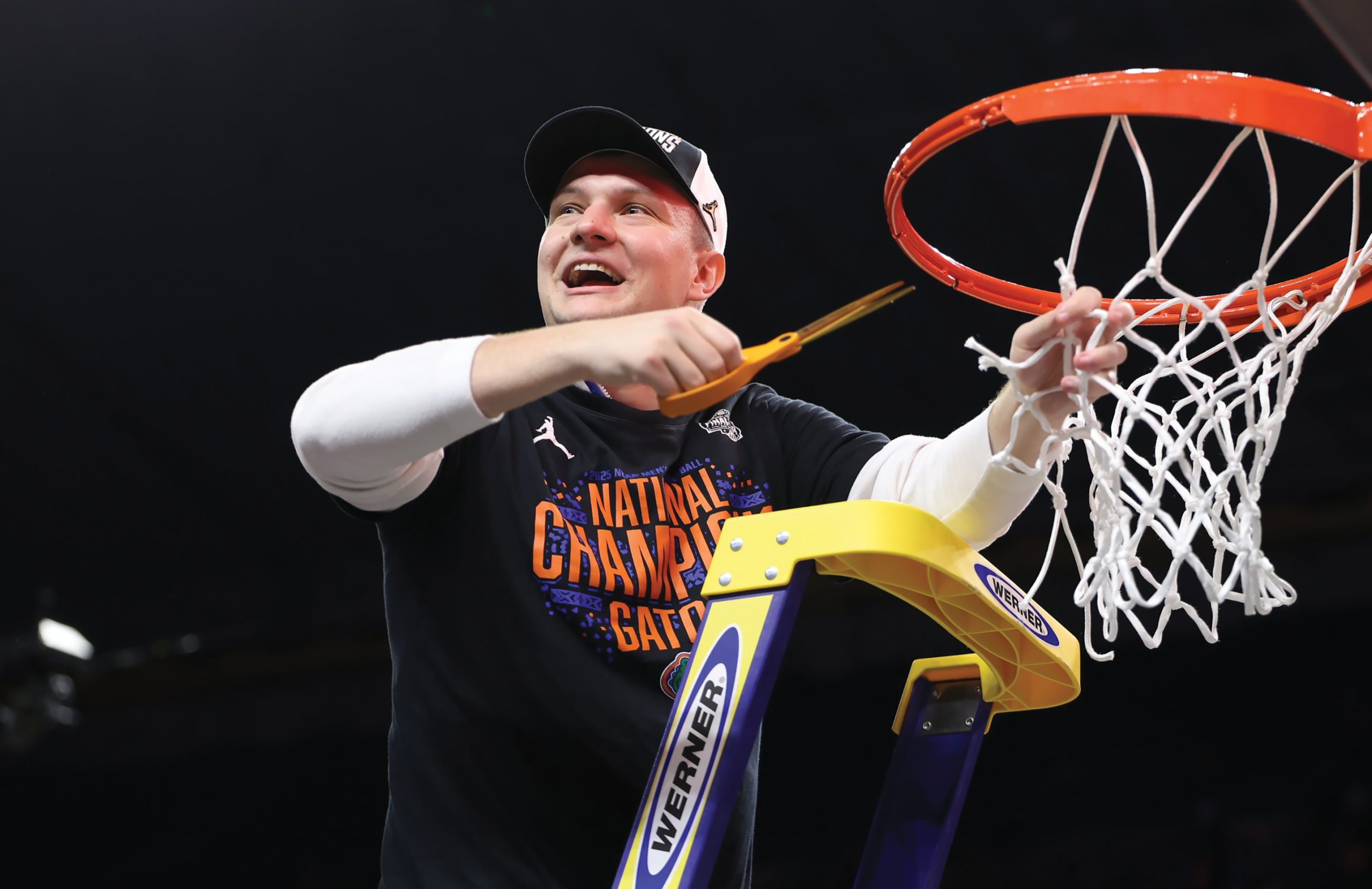
Amid those sought-after hugs, the confetti and climbing a ladder to take his own piece of the net that night, he can’t help but think back to that baseball game. To that moment where it was all on him, and he fell short.
“It was all very cathartic,” he says. “The burden was lifted. I felt like I didn’t have to worry about that anymore.”
Twenty-five days before John Andrzejek became a national champion, he became a Camel.
When Florida beat Tennessee in Nashville to win the SEC Tournament on March 16, Andrzejek didn’t fly back with the team — instead he flew to Raleigh to interview for the vacant head coaching job at Campbell, which parted ways with Kevin McGeehan after 12 seasons (which included the team’s first NIT appearance in 2019).
That evening, Andrzejek’s team learned it would also be heading to Raleigh for the first two rounds of the NCAA Tournament. A day before the No. 1 seed Gators faced 16-seed Norfolk State at the Lenovo Center, Andrzejek was surprised by Campbell Athletic Director Hannah Basemore and Deputy AD Justin Wilkins, who presented him with a term sheet to become the program’s sixth head coach since joining Division I in 1977. News spread quickly that afternoon, sparking a whirlwind weekend of congratulation calls and texts, interview requests and — not to be forgotten — two tournament games (including a two-point squeaker against UConn in the second round).
“I think with a clearer mind, we could have probably guarded UConn a little bit better,” Andrzejek says with a laugh. “You can say that in hindsight. But it all worked out.”
There were a lot of late nights in those 25 days, as Andrzejek says he struggled with how to divide his time between the team he helped
build in Gainesville and the team he wanted to build in Buies Creek. He credits the man who would become his associate head coach at Campbell, Landry Kosmalski, for helping him set his priorities and focus on the team in Florida that needed him for at least three more weeks.
“I was conflicted, because I knew I needed to build a staff and start recruiting at Campbell. But I also owed these Florida kids a chance to live out their dreams and reach the Final Four,” he says. “And it was Landry who helped me by saying, ‘Hey, the best thing for Campbell is you guys winning a national title. Even if we get behind on recruiting, [a national championship] will help our brand. It’ll help us attract more talented guys. So, it’s OK … you’re not cheating Campbell by going 70-30 for Florida. Just make sure you win the Final Four.’”
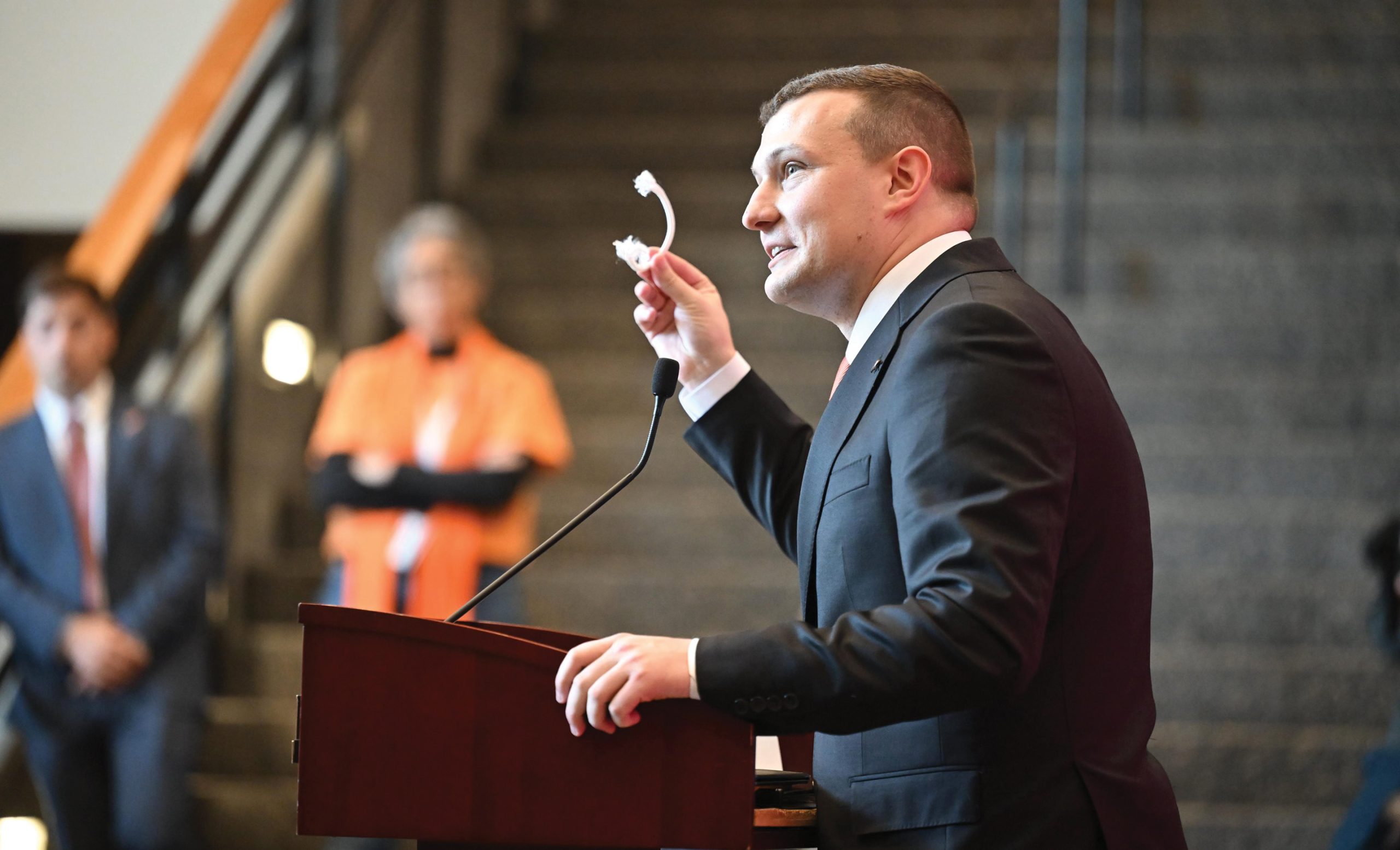
On April 9 — just two days after climbing the ladder and cutting the net — Andrzejek stood before a packed lobby in the Pope Convocation Center and was formally introduced to the community as head coach for a Campbell program that hasn’t seen the NCAA Tournament since 1992 (before Andrzejek was born). As he stepped to the podium, he looked around and mouthed the word “Wow” before beginning his speech, which touched on his expectations and what style of basketball fans could come to expect in the coming years.
“[The moment] hit me — this is my opportunity,” he recalls. “I get a chance to take over this program, I get to work with these people, and I get to be a part of this community. You spend all this time preparing and trying to get the job — then you realize this is all real. It was genuinely one of the best moments I’ve ever had.”
Andrzejek brought a friend to his opening press conference and revealed it midway through his speech. The six-inch piece of white nylon rope from the net he helped cut down in San Antonio received the second largest applause that day.
“That piece of thread is just symbolic,” he says. “There will be struggles, but [the net] shows that you can do anything. I’ve been a part of a lot of great teams that had success and can be proud of that success for a long time. But actually finishing on top is special. It’s something I’ll never forget.”
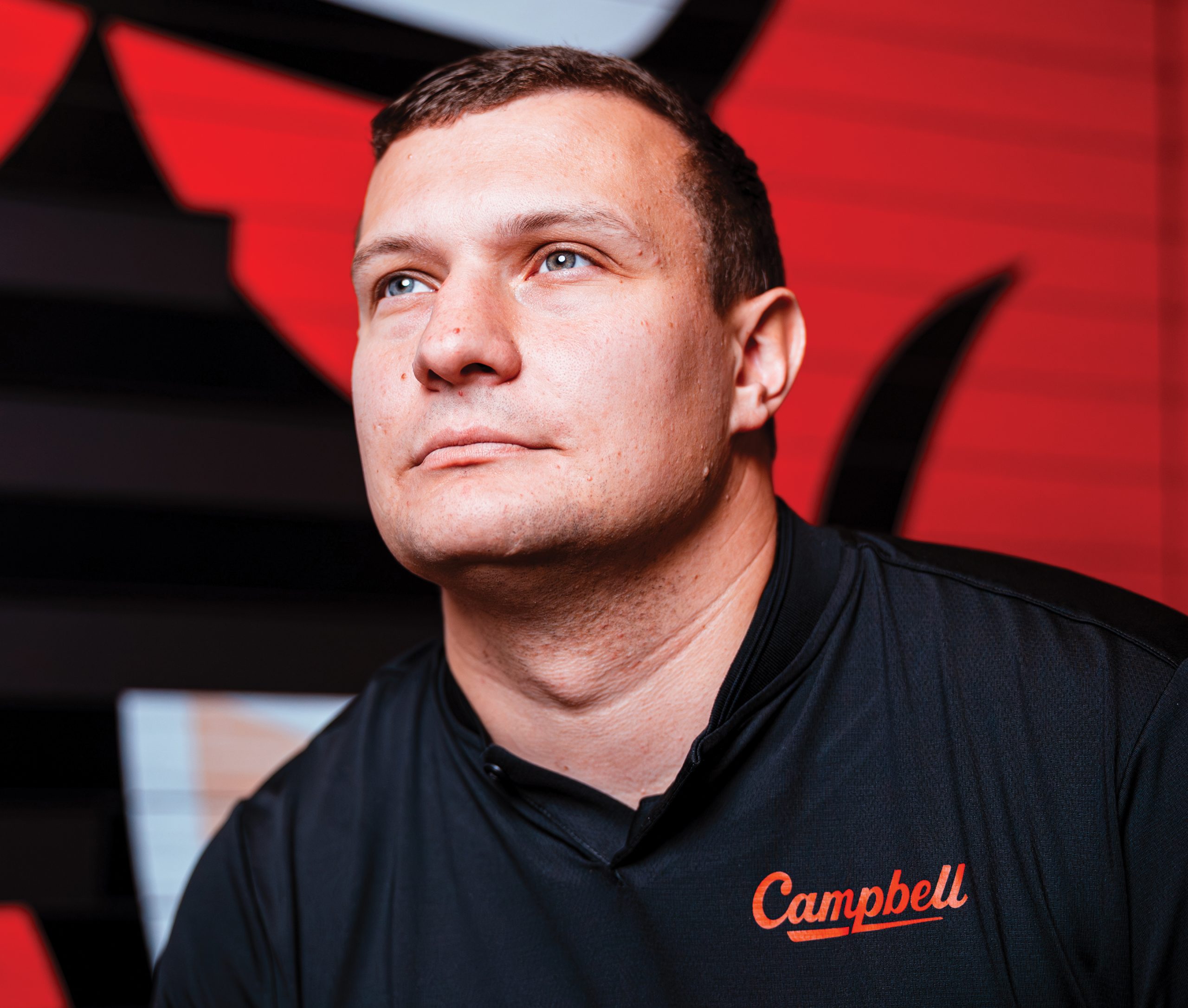
His build and athletic ability might have been more suited for baseball or even football, but basketball was always Andrzejek’s first love.
“I was a pass-first guy,” he says. “Good passer. I played hard. Tried to rebound. Not a great shooter.”
He played all three sports growing up in tiny Hamilton, New York, a town roughly the size of Lillington and home to Colgate University. The salutatorian of his 2011 graduating class, Andrzejek was a member of the school newspaper, the Colgate Seminar Program, French Club, Model U.N. and Mathletics club. He was accepted into an Ivy League school — Columbia University — as a John Jay Scholar and had it in his mind that he would one day be a teacher or professor in philosophy or psychology. Maybe even math.
But he also wanted to be a high school basketball coach. And when he got to Columbia, he sent an email to Head Basketball Coach Kyle Smith and asked if he needed someone to help out.
“I think the No. 1 reason he replied is because I said I was from Hamilton, and he played at Hamilton College,” Andrzejek says. “That kind of started the butterfly effect.”
He earned a degree in philosophy in just two and a half years, graduating with a 3.85 GPA while also working full time as Smith’s team manager and assistant to the director of operations (he also played for the program’s junior varsity squad). He was charged with coordinating videos from the coaching staff and managing Smith’s “unique” statistical database (Smith’s coaching style was dubbed “Nerdball” because of his early use of analytics in his decision making). After graduation, Andrzejek became Columbia’s director of basketball operations in 2014. He followed Smith to the University of San Francisco in 2016 before landing his first assistant coaching job at Johns Hopkins.
Under Smith (now the head coach at Stanford University), Andrzejek says he learned a lot from an approach that blended analytics with an “old school” approach.
“It’s all about accountability,” he says. “It’s about finding blue-collar guys who may have been underappreciated on the recruiting trail. Guys from different backgrounds who have great attitudes and great work ethics. It’s about working hard and having fun, growing from where you’re planted, taking pride and being in the moment.”
Columbia went 25-10 during the 2015-16 season — the school’s best season in decades — and won the CollegeInsider.com Postseason Tournament. Smith, with Andrzejek by his side, would post winning seasons in all three years at San Francisco and three of his five seasons at Washington State (including an NCAA Tournament win in 2024) before taking the Stanford job.
“The biggest thing I can say about his programs is he spends a lot of time and takes a lot of care into making sure he gets the right people on the bus, so to speak,” Andrzejek says of Smith. “Every manager, every coach and every player … there’s an extensive vetting process. He really gets to know people — what makes them tick — and he’s not afraid to pass on some big talent if they’re not going to fit the culture. And I think that’s hard to do. Nowadays, you’re kind of ingrained to just take the most talent and try to figure it out. But he has the self confidence to make sure he gets the people who are going to get along, going to be good teammates and good coworkers, and they’re going to be a good fit for the program.
“That’s the kind of coach I want to be.”
One of the other coaches who got his start at Columbia and followed Smith to San Francisco was a young man named Todd Golden, who became the successor at USF when Smith moved on with Andrzejek to Washington State. In his third year, in 2022, Golden led the Dons to a 24-10 record and their first NCAA Tournament appearance in 24 years. The day after his first-round loss to Murray State, Golden was named head coach at the University of Florida.
After a 16-17 first season, Golden reached out to Andrzejek in 2023 to become his assistant. In Andrzejek’s two seasons under Golden at Florida, the Gators posted a 50-16 overall record, two trips to the NCAA Tournament and one national championship.
When Andrzejek took the Campbell job, Golden spoke of those days at Columbia and the coaching tree that has grown under Smith in the last 10 years.
“That staff has five head coaches now, and we were not that good, which makes it even better,” Golden said. “I’m incredibly proud, [and] I know my mentor Kyle Smith is incredibly proud that people are appreciating what, for lack of a better term, our tree has been able to do in college. When you see a guy like John get an opportunity at a great place like Campbell to come in and take over the job and see what he’s able to do with his imprint on the program, he knows he has my full support. Myself and Kyle will be there for him whatever he needs.”
Andrzejek says he’s sought advice from his mentors since taking the job, and the message has been the same — just be yourself.
“I think there’s a trap that some new head coaches fall into where they try to just be a facsimile of their mentors, but it’s a balancing act,” he says. “You’ve got to take the great things that you learned from them and make those a part of your identity and philosophy, but you have to be uniquely yourself, too. Players are going to sniff it out if you’re trying to be somebody else or if you’re trying to be phony. That’s never been a problem for me.
“I realize that as a head coach in this modern era — with the transfer portal and revenue sharing and NIL — you’re also a CEO. There’s a lot to this job, and you need to be able to hire people who are elite in their own right and trust them to do what they’re good at. I can’t micromanage every little aspect and expect to succeed.”
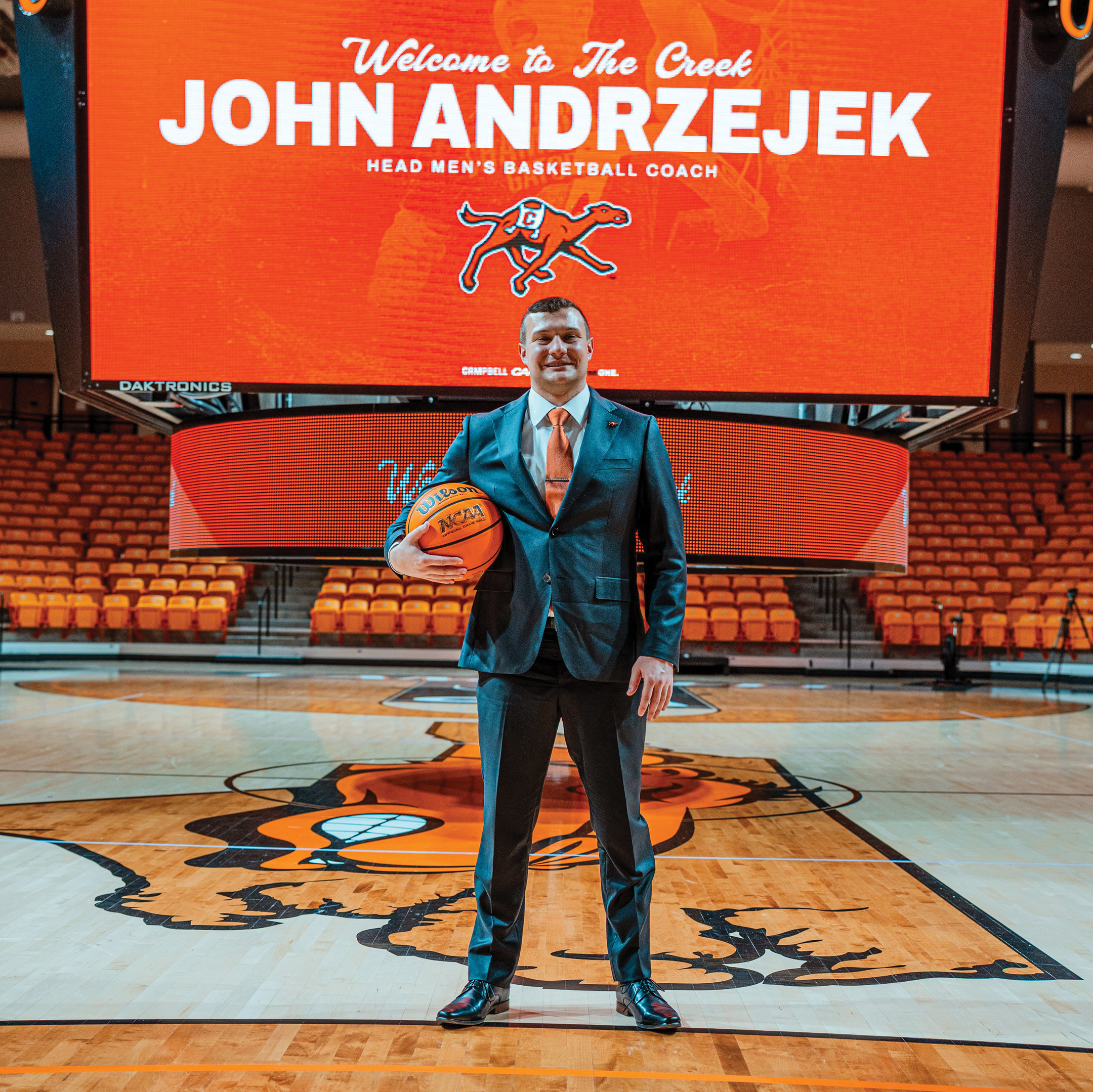
The average age of a first-time college basketball head coach at the Division I level is between 42 and 43 years old. At just 32, Andrzejek — despite his experience and the “skins” he’s accumulated as an assistant — is still considered a “pup” in the game. Asked over the summer why now was the right time and why Campbell was the right fit, he flipped the calendar back a few months to December — Christmas Eve, to be exact — and the night he proposed to his now-fiancé.
“After I proposed, people asked me, ‘How’d you know she was the one?’ and the answer I gave then is the answer I give now,” he says. “When you know, you just know.”
Since his hiring, Andrzejek has immersed himself in the Campbell community, buying a home in nearby Angier and getting to know Camel fans, whether they’re approaching him at the grocery store or at the handful of Campbell Caravan events hosted by Campbell Athletics over the summer. In several interviews, he’s compared Buies Creek to his hometown of Hamilton and even the town of Pullman, Washington, where he coached at WSU for three seasons.
It’s been over 30 years since Campbell has been to the NCAA Tournament. Camel fans, Andrzejek says, are excited and hungry for a winner.
“They want us to be successful, but these are smart fans. They understand it’s going to take a little time,” he says. “Don’t get me wrong, this team and this staff are focused on having a great year and going as far as we can go, but I’m not going to put a ceiling up just yet. I think we’ll be capable of a lot. But we have to build things the right way and build it organically.
“Everyone from our coaching tree is a big believer in process over results. Build the type of program we want and trust that it will lead to us getting to where we want to go.”
The roster heading into the fall included just four holdovers from last year’s 15-17 team that finished fifth (out of 14) in the Coastal Athletic Association last spring. Of the four, Cam Gregory and Tasos Cook saw significant playing time last year, averaging roughly 8 and 5 points a game, respectively. The rest of the roster features transfers from other mid-major programs — including NCAA Tournament teams Norfolk State and Robert Morris and larger programs like Pepperdine, Western Kentucky and Green Bay-Wisconsin. Andrzejek looked for guys who played big roles on those teams (most averaged between 9 and 13 points a game) and who understand what it takes to win at the mid-major level.
“The most important thing is I need guys with great attitudes, who work really hard and who want to be here,” he says. “Having a great attitude means being a fountain, not a drain. Being a light bulb and bringing energy to a room. We’re up front about playing in a small town, which has led to a lot of self-selecting and a roster of really good kids. You have to be proud to be here. And I think that’s what we’re building.”
Like Florida, Campbell’s squad under Andrzejek will feature two “bigs,” run hard, play a side-to-side style and rely on heavy ball screens and a motion offense. Defensively, his teams will be physical, keep teams out of the paint and “ice on the side-ball screens.” While there will be nuance and changes here and there, the overall blueprint will remain the same. If it ain’t broke, don’t fix it.
“I did a little exercise with our team this summer,” Andrzejek says. “I asked them, ‘Do you know when the Florida players last year made it a goal for themselves to win a national title?’ I went around the room, and they said, ‘Sept. 1,’ ‘the first game of the year’ or ‘during the summer.’ Everyone had different answers. But I said, ‘No. We never made it a goal.’ Process over results. Before every game, Todd Golden told the team they needed to prove they’re one of the best teams in America. From the first game to the national title game. The same message.
“You can come in to a new program making too many goals, because sometimes great things happen a little ahead of schedule, and sometimes it’s slightly behind schedule. We want to build this into one of the best programs of the CAA. If there’s a goal, that’s it. We want our quality to be really high, and we’ll just trust that if each year we’re one of the best two, three or four programs in the conference, that will eventually lead us back to the NCAA Tournament.”